
How does it work?
Similar to the Caesar cipher, the Vigenère cipher shifts each letter of the input. However, instead of using a fixed shift value, the Vigenère cipher shifts each letter a different amount, determined by a keyword.
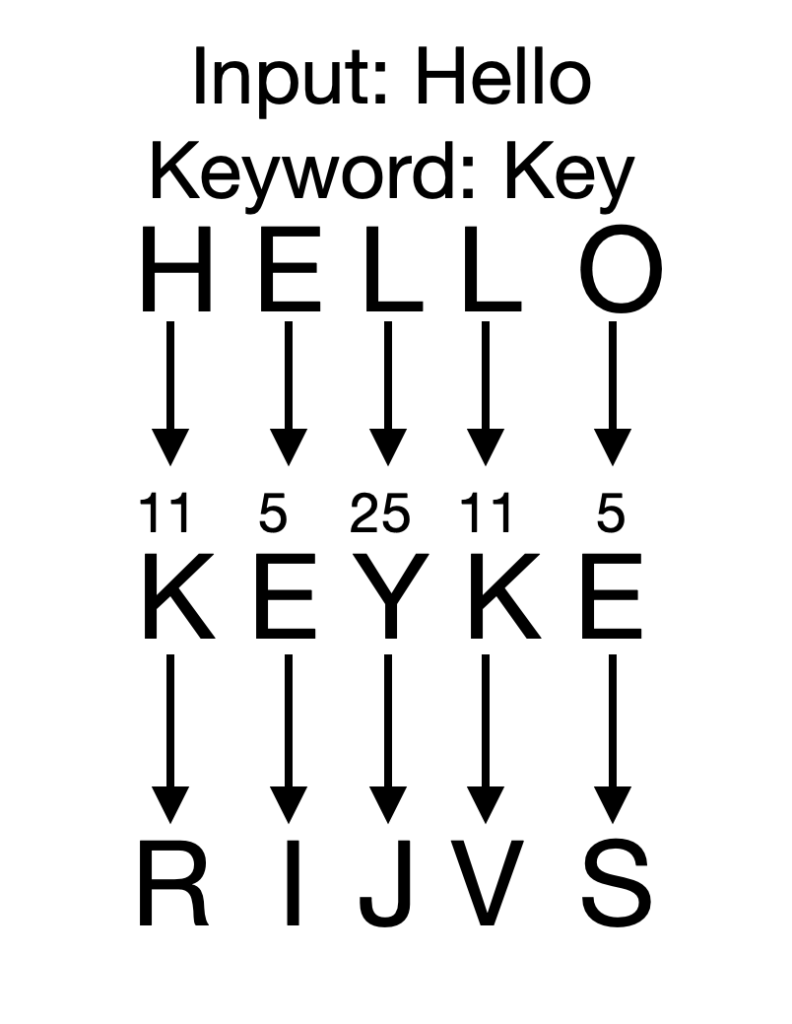
For example, if our keyword is “KEY” and the message we want to hide “HELLO”, the first letter of the keyword, “K”, is the 11th in the alphabet. By shifting “H” 11 positions, we obtain the encrypted letter “S”. The process continues with the second letters of the keyword and input. When the keyword ends, it loops, as seen on the right. This process is repeated in reverse to decode the message.
When performing a Vigenère cipher manually, a table of letters known as a ‘Vigenère square’ is used to encode and decode messages quickly, removing the need to do mental arithmetic.
The Vigenère Cipher is very secure for a simple cipher as it’s hard to break using methods like brute force or frequency analysis. It also exclusively uses standard letters, making it easier for computers to deal with.
However, it isn’t perfect. It’s far more complex than ciphers like Caesar, and despite the helpful table, takes longer to encode and decode messages. It also has the downside of needing a shared keyword for the writer and reader. If a third party gains access to the keyword, all messages written using it are free for them to read.
Where is it used?
In the modern world, the Vigenère cipher is mostly utilised for educational purposes, teaching the fundamental concepts of encryption, and as a recreational encryption method in puzzle games, escape rooms, or other non-critical scenarios. It serves as a stepping stone for individuals interested in cryptography, providing a practical hands-on experience while understanding the limitations and vulnerabilities of historical encryption methods.
History
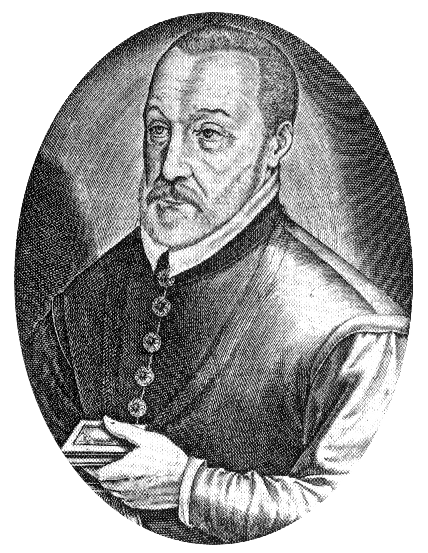
The Vigenère cipher has been employed in various historical contexts. One notable example is its use by military and diplomatic figures throughout history. In the 16th century, diplomat Blaise de Vigenère popularized the cipher and it became widely known as the Vigenère cipher, named after him. The Vigenère cipher was considered secure for centuries and was extensively used until the 19th century.
Despite its historical significance, the Vigenère cipher also suffers from certain vulnerabilities. One of the primary weaknesses is the vulnerability to key length discovery. If the length of the keyword is exposed, it becomes easier for attackers to decrypt the message. Furthermore, with the advent of more advanced cryptographic techniques and computers, the Vigenère cipher is no longer considered secure for protecting sensitive information.
More Information
If you’d like to know more about the Vigenère, have a look at these:
- https://en.wikipedia.org/wiki/Vigenère_cipher
- https://cryptography.fandom.com/wiki/Vigenère_cipher